
HERSHE News
Can Deep Nasolabial Folds Be Improved with a Mini Facelift?

When you look in the mirror, your face may not seem very different. However, when you take a photo,
you may suddenly feel that you look older than before. Or perhaps nasolabial folds that used to appear only when you smiled have gradually b
ecome noticeable even when your face is at rest.
If so, it may be worth looking more closely at why your nasolabial folds have become deeper.
When nasolabial folds become more pronounced, it is easy to think:
“Since it’s a wrinkle, shouldn’t I just fill in the sunken area?” “Will filler make my nasolabial folds disappear?”
“My cheeks seem to have sagged. Do I need a lifting procedure?”
In fact, nasolabial folds cannot always be explained simply as lines that have formed on the surface of the skin.
The face consists of multiple interconnected structures, including the skin, subcutaneous fat, SMAS (superficial musculoaponeurotic system), and retaining ligaments.
As aging progresses, changes in skin elasticity and shifts in the position of the soft tissues
and fat that make up the cheeks can make the boundary around the nasolabial folds appear more pronounced.
Therefore, if you are concerned about deep nasolabial folds, rather than focusing only on:
“How can I get rid of this wrinkle?” it is important to first ask:
“Why have my nasolabial folds become deeper?”

Why Do Nasolabial Folds Become Deeper Over Time?
Nasolabial folds are natural facial contours that extend from the sides of the nose toward the corners of the mouth.
Therefore, simply having nasolabial folds does not necessarily mean that your face is aging.
The concern arises when these folds become deeper and more noticeable than they used to be.
Age-related facial changes do not occur only in the skin. Changes in skin elasticity,
facial fat compartments, and the structures that support them can all play a role.
The retaining ligaments of the face help support the soft tissues,
and changes in these structures and the surrounding tissues are closely associated with the aging process.
Several factors can make nasolabial folds appear deeper.
1. Changes in Skin Elasticity
As time passes, the skin may gradually lose some of its elasticity, making it more difficult
for the skin around the cheeks and mouth to maintain the same firmness as before.
As a result, folds around the nasolabial area may become more noticeable.
2. Sagging of the Cheek Tissues
This is one of the important factors to consider when evaluating nasolabial folds.
As the soft tissues of the cheeks shift downward, volume may become more concentrated above the nasolabial fold, making the fold appear more pronounced.
Anatomical studies have also described how changes and sagging of the skin and fatty soft tissues
of the cheeks can contribute to facial aging patterns, including more prominent nasolabial folds.
3. Changes in Facial Volume
The distribution and volume of facial fat can also change with age.
Some areas may lose volume while other tissues shift downward, changing the contours of the face.
As a result, nasolabial folds may appear relatively deeper.
4. Individual Facial Structure
Natural differences in the cheekbones, maxillary structure, cheek volume, and skin thickness can also influence the appearance of nasolabial folds.
For this reason, some people may have relatively prominent nasolabial folds even at a younger age.
Ultimately, even when nasolabial folds look similar, the underlying causes can differ from person to person.
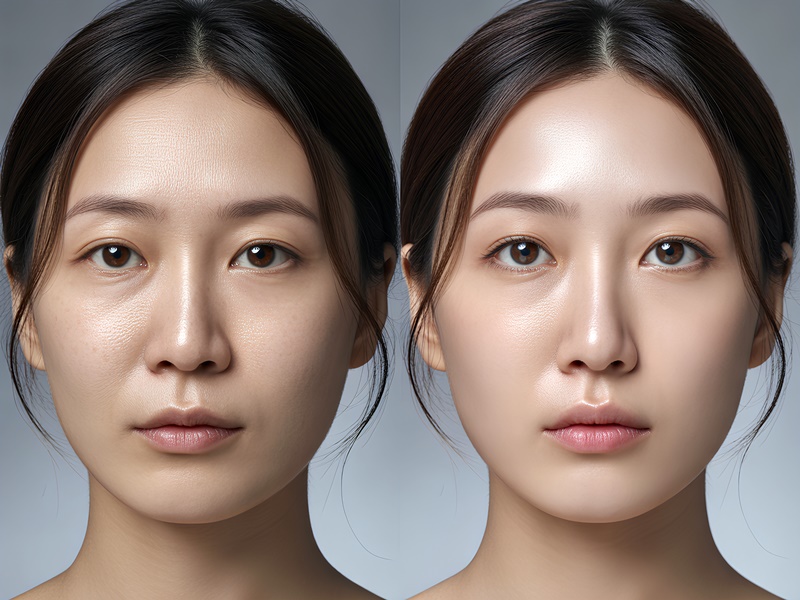
What Is a Mini Facelift for Nasolabial Folds?
A mini facelift for nasolabial folds should not simply be understood as a procedure that directly stretches out a single wrinkle.
Rather, it can be considered a surgical lifting approach that takes into account the sagging
cheek tissues and changes in the mid-to-lower face that can make nasolabial folds appear deeper.
HERSHE Plastic Surgery also explains that deep facial wrinkles and sagging are not caused solely by changes in the skin.
Deeper structures, including the SMAS layer, may also need to be considered.
In other words, the goal is not simply to pull the surface of the skin tightly in an attempt to flatten the nasolabial folds.
Instead, it is important to evaluate factors such as:
Where the cheek tissues have begun to sag
How much tissue has descended above the nasolabial folds
The degree of sagging in the midface and lower face
The condition of the skin and deeper tissues
Based on these factors, the appropriate lifting direction and surgical range can be planned for each individual.

Who May Consider a Mini Facelift for Nasolabial Folds?
Having nasolabial folds does not automatically mean that a mini facelift is necessary.
However, if you notice the following changes, you may consider consulting with a medical professional to determine whether a surgical lifting approach is appropriate.
1. If Your Nasolabial Folds Have Become Deeper Over Time
If your nasolabial folds were not particularly prominent when you were younger but have gradually become deeper,
it may be helpful to determine whether sagging of the cheeks and surrounding tissues is contributing to the change.
2. If Your Cheeks Appear to Sag Above the Nasolabial Folds
If the problem is not simply a hollow nasolabial area, but rather cheek tissue that appears to have descended
and accumulated above the folds, changes in the position of the cheek tissues may also need to be evaluated.
3. If You Are Concerned About Both Nasolabial Folds and Sagging Cheeks
If your cheeks have begun to descend and your overall facial contour also looks heavier than before,
it may be more appropriate to assess the overall position of the facial tissues rather than focusing only on a single wrinkle.
4. If Volume Enhancement Alone May Not Address the Main Concern
If tissue sagging is more significant than volume loss in the nasolabial area,
a treatment plan that approaches the underlying tissue position may be considered rather than focusing only on adding volume.
5. If Your Sagging Is More Localized Rather Than Widespread
If your primary concerns are nasolabial folds and sagging around the cheeks rather than extensive aging changes throughout the entire face and neck,
a more limited lifting approach may be discussed depending on your condition.
What Should Be Evaluated Before a Mini Facelift for Nasolabial Folds?
During consultation, several factors should be evaluated together.
1. Depth of the Nasolabial Folds
It is important to determine whether the folds are primarily caused by skin creasing or whether sagging cheek tissues are also contributing.
2. Position and Volume of the Cheeks
The degree to which the cheek tissues have descended should be assessed, as well as whether there is simultaneous volume loss or hollowing.
3. Skin Elasticity
The current elasticity and condition of the skin should also be evaluated.
4. Sagging of the Midface and Lower Face
It is important to determine whether the concern is limited to the nasolabial folds or whether
sagging also extends to surrounding areas such as the corners of the mouth and jawline.
5. Overall Facial Proportions
Rather than making an excessive change to one specific area, the treatment plan should consider
how the result will harmonize naturally with the person's existing facial structure.
Through this assessment, it may be possible to determine more specifically whether volume enhancement such as fillers,
a non-surgical lifting procedure, or a surgical approach such as a mini facelift may be appropriate.

What Is Recovery Like After a Mini Facelift for Nasolabial Folds?
Recovery can vary depending on the extent of surgery and each individual's healing process.
During the early recovery period, temporary symptoms such as swelling, bruising, a tight sensation, discomfort around the incision, or changes in sensation may occur.
The timing for returning to normal daily activities can also vary depending on the surgical range and individual condition.
If you have an important appointment, photo shoot, event, or other scheduled activity, it is advisable to plan the surgery with sufficient recovery time in mind.
After surgery, it is also important to avoid excessive irritation around the incision and refrain from strenuous exercise until advised by your medical team.
Recovery itself is part of the surgical process, so attending scheduled follow-up appointments and following postoperative instructions are important.

Deep nasolabial folds do not always have one single solution.
Their appearance can be influenced by multiple factors, including changes in skin elasticity,
sagging cheek tissues, changes in facial fat and volume, changes in the retaining ligaments and surrounding tissues, and individual facial anatomy.
Therefore, rather than viewing nasolabial folds simply as “grooves that need to be filled,” it is important to first determine:
Why have they become deeper than before? How much is cheek sagging contributing to their appearance?
Are there also changes in the midface and lower face surrounding the nasolabial folds?
A mini facelift for nasolabial folds should likewise be considered not simply as a surgery that strongly pulls on a single wrinkle,
but as an approach that may help address the underlying factors making the folds more prominent
by repositioning sagging cheek and surrounding tissues according to the individual's condition.
At HERSHE Plastic Surgery, we consider not only the depth of the nasolabial folds, but also skin elasticity, cheek position and volume,
the degree of midface and lower-face sagging, and overall facial balance when planning an individualized lifting approach.
Ultimately, the key question is not: “How much can my nasolabial folds be removed?”
but rather: “Why have my nasolabial folds become deeper?”
 다음글
다음글 게시물이 없습니다.

 힙업리프팅으로 애플힙 뒤태 만들수있나요? 힙업성형 Q&A
 어깨필러 상담부터 시술과정까지, 직각어깨 REAL 현장
 쌍수하고 술 언제부터 마셔도 되나요?


 이전글
이전글