
HERSHE News
Why Does Your Overall Appearance Look Different After Under-Eye Fat Repositioning?

Some people are bothered by noticeable under-eye bags whenever they look in the mirror,
or by an appearance that seems constantly tired even after getting enough sleep.
You may have experienced thoughts or comments like these:
“I feel fine, but people often tell me I look tired.”
“I thought it was just dark circles and tried covering them with makeup, but my under-eyes still look dark.”
“My under-eye bags and shadows look even more noticeable in photos.”
“I’ve heard that under-eye fat repositioning can change your overall appearance. Why is that?”
The reason your appearance may look different after under-eye fat repositioning is not simply because there is less fat under the eyes.
The under-eye area is close to the center of the face and naturally draws attention.
Even relatively small changes in volume or shadows in this area can make the face appear tired or darker.
HERSHE Plastic Surgery also explains that when protruding under-eye fat sits next to a hollow area beneath it,
the difference in contour can create shadows. As a result, the under-eye area may look dark or tired regardless of the actual skin tone.
Today, we’ll take a closer look at why your overall appearance may change after under-eye fat repositioning and
how the structure of the under-eye area can influence the impression of the entire face.

Even Small Changes Under the Eyes Can Affect Your Overall Appearance
The appearance of the under-eye area is influenced by more factors than you might expect.
The position of under-eye fat, the depth of the tear trough, skin thickness, skin tone,
visible blood vessels, and underlying bone structure can all contribute to how the area looks.
This means that even if two people appear to have similar dark circles, the actual causes may be different.
At HERSHE Plastic Surgery, the causes of dark circles can generally be considered in the following ways.
1. Shadows Caused by Protruding Under-Eye Fat
When under-eye fat protrudes forward, it can create a shadow directly beneath the bulging area.
The skin itself may not actually be darker. Instead, the difference in height between
the protruding and hollow areas can create a shadow that makes the under-eye area look dark.
2. Hollowness-Related Shadows
When the area extending from beneath the eyes toward the upper cheek appears hollow, a valley-like shadow may form.
3. Thin Skin and Visible Blood Vessels
If the skin beneath the eyes is thin, underlying blood vessels may show through, creating a bluish or purplish appearance.
4. Pigmentation
In some cases, pigmentation itself may be responsible for making the under-eye area look darker.
Therefore, not all dark circles or under-eye concerns are suitable for under-eye fat repositioning.
The first step is to identify why the under-eye area looks dark or tired.

Why Can Your Appearance Look Different After Under-Eye Fat Repositioning?
1. The Shadows Under the Eyes May Change
When under-eye fat protrudes forward while the area beneath it is hollow, a shadow can form along the border between these two areas.
Depending on the lighting or photography conditions, this shadow may appear even more pronounced.
This is why someone may hear comments such as, “You look really tired today,” even when they are actually well rested.
Under-eye fat repositioning is designed to address the contour difference between protruding and hollow areas.
As the uneven transition and resulting shadows are reduced, the overall impression of the eyes and face may appear different.
2. The Structure That Creates a “Tired Look” May Become Smoother
Prominent under-eye bags can make a person appear tired or older regardless of their actual condition.
When protruding under-eye fat and hollowness occur together, the upper area may appear bulging while the area directly beneath it looks sunken.
This difference in contour can further emphasize shadows beneath the eyes.
Under-eye fat repositioning takes into account the position of the fat and the tear trough according to each individual’s anatomy.
By creating a smoother under-eye contour, the overall facial impression may also appear more balanced.
3. The Central Face May Appear Brighter
The eyes are one of the first areas people naturally look at when viewing a face.
If there are pronounced shadows or bulges beneath the eyes, the entire face may appear darker or more fatigued.
Conversely, when the under-eye volume and contour become smoother, the surrounding shadows may be reduced,
making the overall facial impression appear brighter and more refreshed.
This is why some people feel that their appearance has changed after under-eye fat repositioning
even though the actual shape of their eyes has not been significantly altered.
4. The Contrast Between Bulging and Hollow Areas May Be Reduced
The appearance of the under-eye area is not determined simply by how much fat is present.
What matters is where the volume protrudes and where the area is hollow.
For example, if under-eye fat protrudes forward while the tear trough directly beneath it is deeply hollow,
the contrast between these two areas may become more pronounced.
Therefore, simply removing protruding fat may, depending on the individual’s condition, make volume loss or hollowness appear more noticeable.
HERSHE Plastic Surgery also emphasizes that under-eye surgery should consider
the overall volume balance and a smooth under-eye contour rather than focusing solely on excessive fat removal.
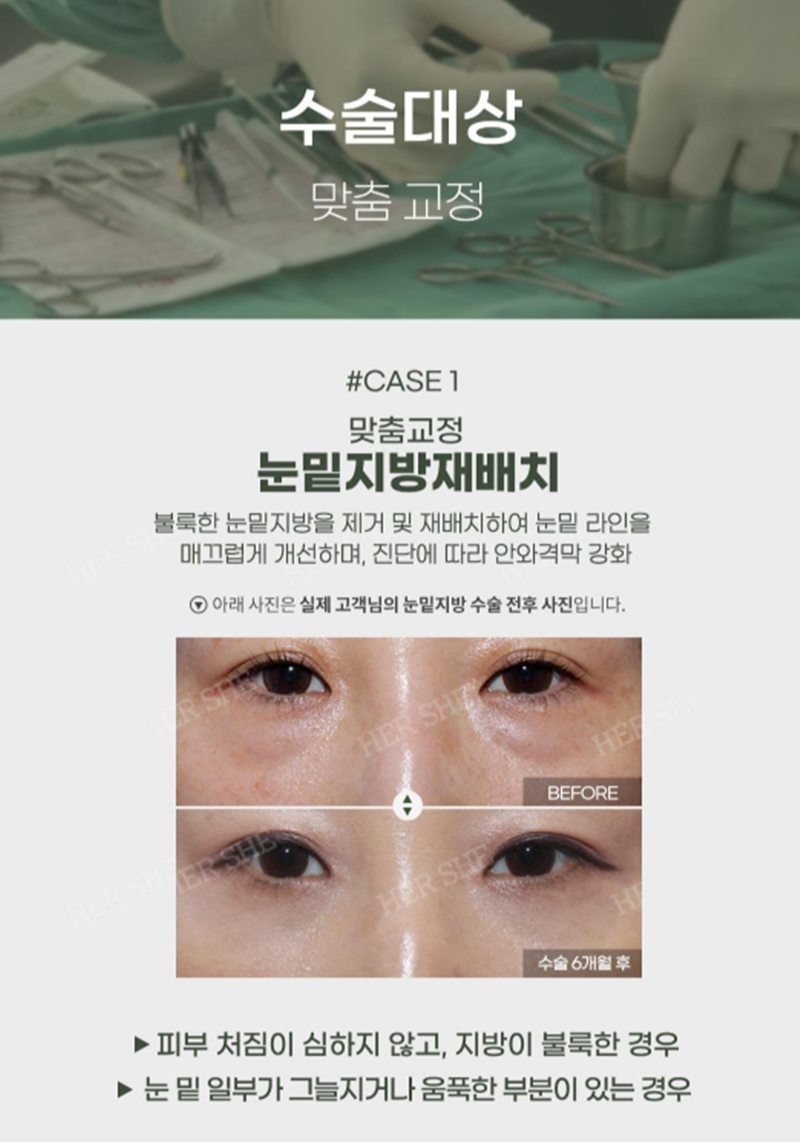
Who May Consider Under-Eye Fat Repositioning?
Under-eye fat repositioning is not a procedure that can be applied in the same way to every under-eye concern.
You may consider consulting with a medical professional if you have concerns such as the following.
1. The Under-Eye Area Consistently Looks Puffy or Bulging
The under-eye area appears prominent even when you are not smiling, with visible shadows beneath the bulging area.
2. Both Bulging and Hollowness Are Present
The central under-eye area appears full or protruding, while the tear trough or upper cheek beneath it appears hollow, creating an uneven contour.
3. You Are Often Told You Look More Tired or Older Than You Feel
Even after adequate rest, structural shadows beneath the eyes can contribute to a tired appearance.
4. Your Under-Eye Area Looks Especially Noticeable in Photos
Lighting and camera angles can make protruding fat and under-eye shadows appear more pronounced.
5. Your Dark Circles Appear to Be Caused More by Shadows Than Pigmentation
If the darkness is primarily caused by shadows created by protruding fat and adjacent hollowness rather than the actual color of the skin,
a different approach may be considered after evaluating the underlying cause.
Can People in Their 20s and 30s Consider Under-Eye Fat Repositioning?
Under-eye fat repositioning is not necessarily limited to older individuals.
Protruding under-eye fat can develop as part of the aging process,
but it may also become noticeable at a relatively young age due to genetics or individual anatomical characteristics.
Some people in their 20s and 30s may have prominent under-eye fat combined with hollowness beneath it, making them appear more tired than they actually are.
Therefore, age alone should not determine whether under-eye fat repositioning is appropriate.
It is more important to evaluate the current structure of the under-eye area, the degree of fat protrusion, hollowness, and skin condition.
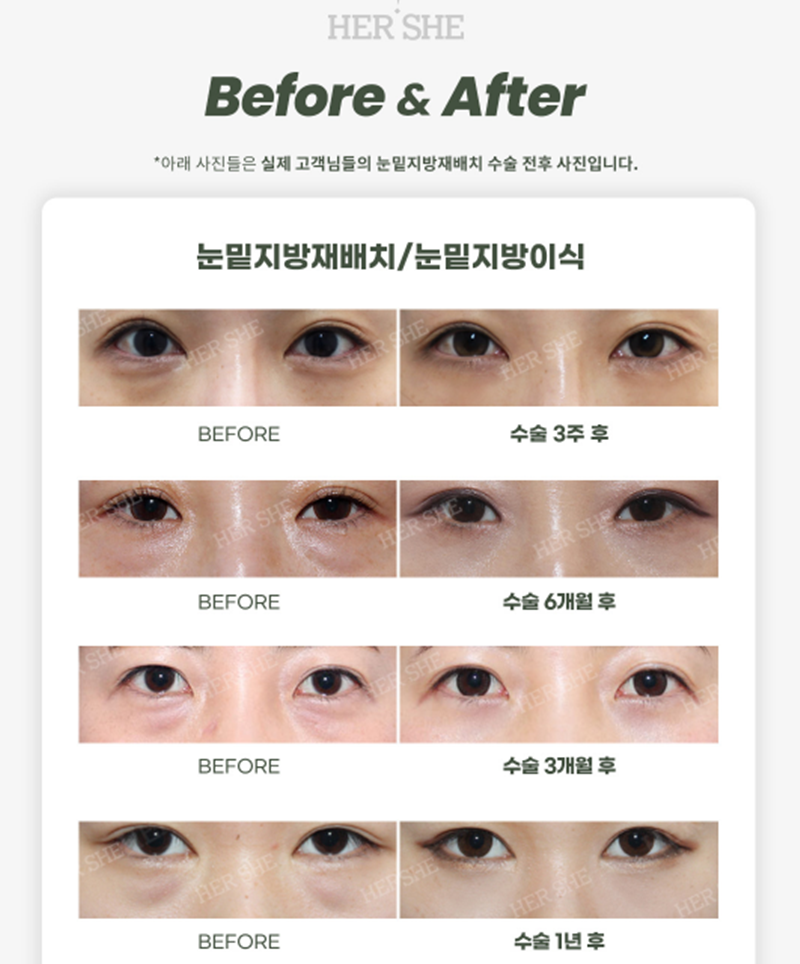
r The reason your appearance may look different after under-eye fat repositioning is not necessarily
because the shape of the eyes themselves has changed significantly.
Rather, it may be because the bulging and hollow areas beneath the eyes,
along with the shadows created between them, have changed.
When under-eye fat protrudes while the area beneath it is hollow, shadows can make dark circles appear more pronounced
or create a tired-looking impression regardless of the actual skin tone.
Depending on the individual’s condition, adjusting the volume distribution and contour beneath the eyes may create a smoother transition and
change the overall impression of the face.
However, not every under-eye concern can be addressed with under-eye fat repositioning.
Dark circles may be related to pigmentation, visible blood vessels, or skin characteristics, while significant skin laxity may require a different approach.
Therefore, rather than choosing a surgical procedure first, it is important to accurately assess what is causing
the current appearance of the under-eye area and determine an appropriate treatment plan based on the individual anatomy and condition.
 다음글
다음글 게시물이 없습니다.

 힙업리프팅으로 애플힙 뒤태 만들수있나요? 힙업성형 Q&A
 어깨필러 상담부터 시술과정까지, 직각어깨 REAL 현장
 쌍수하고 술 언제부터 마셔도 되나요?


 이전글
이전글