
HERSHE News
If your nasolabial folds have deepened, could a Midface Mini Facelift help improve them?

At some point, there is a change in your face that bothers you every time you look in the mirror. These are nasolabial folds.
The nasolabial folds, which were previously only visible when smiling, became clearly visible even when standing still.
“Your face looks very tired these days.” “I haven’t even lost weight, but my face looks saggy.” “I think I look older because of my nasolabial folds.”
When you start hearing stories like this, you start looking for ways to improve your nasolabial folds. Then, you will naturally compare various methods.
Should I get nasolabial fold filler? Should I get lifting procedures? Or might surgery such as a Midface Mini Facelift be needed?
However, it is difficult to view nasolabial folds as simply wrinkles caused by skin folds.
Especially if the nasolabial folds have become deeper over time,
it is important to look at how the soft tissues of the face have changed rather than the nasolabial folds themselves.
Today, we will examine why nasolabial folds deepen, when a Midface Mini Facelift may be considered, and how it differs from fillers and other lifting procedures.

Aren’t nasolabial folds always there?
That's right.
Nasolabial folds, or nasolabial lines extending from the side of the nose to the corner of the mouth, may exist to some degree in everyone.
It is also the border of the face that naturally appears when smiling or making facial expressions.
Therefore, the presence of nasolabial lines cannot necessarily be considered evidence of aging.
The problem is when nasolabial fold lines, which were not of much concern before, become deeper and clearer with age.
especially
1. Even when you stay still, nasolabial folds start to appear.
2. The cheek flesh above the nasolabial folds appears sagging.
3. Even the area around the mouth looks heavy.
4. It feels like the whole face is lowered
5. If the shadows on the nasolabial area become darker when you take a picture
It is necessary to look into whether it is simply a problem of wrinkles on the skin surface.
Why do nasolabial folds become deeper?
There may be several causes for deepening nasolabial folds.
1. Decreased skin elasticity
As you age, your skin's collagen and elastic structure changes, making it difficult for your skin to stay as tight as it once did.
At this time, as the degree of skin folding increases, the nasolabial folds may appear more clearly.
However, skin elasticity is not everything that causes nasolabial folds.
2. Sagging of cheek tissue
This is especially important when understanding nasolabial folds. The cheeks of the face contain not only skin but also fat and various soft tissues.
As the location and support of these tissues change over time, the cheeks may move downward and the tissue may appear concentrated above the nasolabial folds.
In this case, simply filling in the ‘groove’ of the nasolabial folds may not sufficiently explain the changes in the entire face.
3. Changes in facial fat and volume
During the aging process, not only does the fat on the face simply decrease,
but the curve of the face itself can change as the volume decreases or moves depending on the area.
For example, as some areas turn off and other areas move downward, the boundaries of the nasolabial folds may appear more emphasized than they originally were.
So when I see nasolabial folds “How dark is it here?” as well as “How far has the upper organization come down?” We need to look at it together.
4. Individual facial structure
The appearance of nasolabial folds is not determined solely by the degree of aging.
Depending on the individual facial structure, such as the shape of the cheekbones and maxilla,
cheek volume, and skin thickness, the nasolabial fold may appear relatively clearly.
So, while some people have deep nasolabial folds even at a relatively young age,
there are also people whose nasolabial folds are not very noticeable even as they get older.

What is a Midface Mini Facelift?
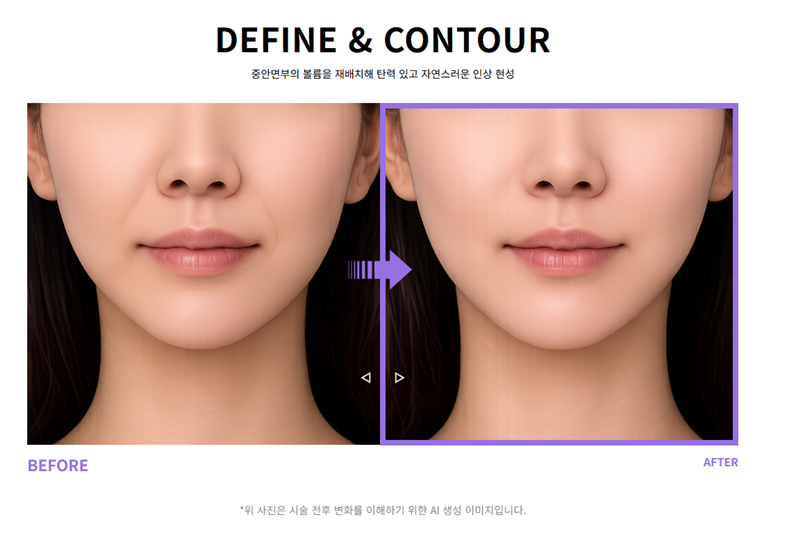
A Midface Mini Facelift can be understood as a relatively limited lifting surgery intended to address nasolabial folds and nearby sagging.
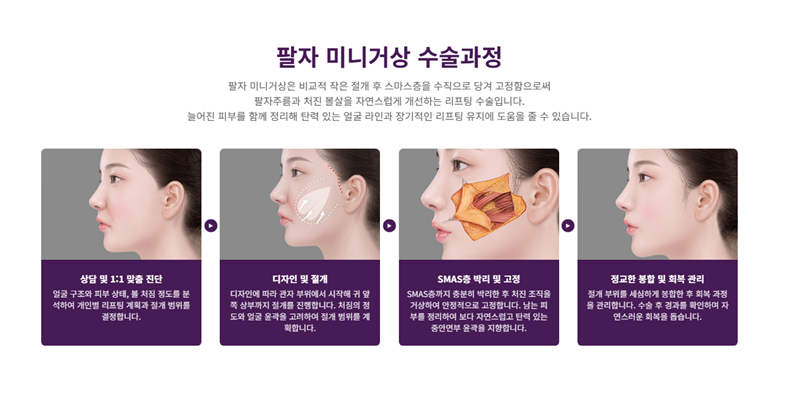
It uses small incisions and dissection from the temple to the area in front of the ear to address sagging cheeks and nasolabial folds that appear deep.
In addition, it lifts not only sagging skin but also subcutaneous tissue such as the SMAS layer and, if necessary, trims excess skin to create a smoother mid-face contour.
That is, Rather than a surgery to forcibly straighten a line of nasolabial folds,
It is best to understand that this is a surgery that takes into account the location of the sagging cheeks and surrounding tissues,
which contribute to the appearance of deep nasolabial folds.
How does a Midface Mini Facelift approach nasolabial folds?
The key points of the Midface Mini Facelift can be easily explained as follows.
1. Check the condition around the nasolabial folds
: Not only the depth of nasolabial folds cheek sagging ,volume ,Skin elasticity ,Mid-facial sagging ,
lower facial sagging ,Ratio of the entire face Check your back together.
2. Check the location of sagging tissue
If the cheek above the nasolabial folds moves down and the nasolabial folds become deeper,
it is important to check the location of the sagging cheek tissue rather than simply looking at the wrinkles.
3. Lifting tissue to the required extent
At HERSHE Plastic Surgery, the Midface Mini Facelift is performed through small incisions to lift subcutaneous tissues such as the SMAS layer and reposition volume.
4. Trim off excess skin
If skin remains after tissue lifting, the skin is trimmed as needed to achieve a more natural outline.
Therefore, the approach may be different from simply pulling strongly on the skin surface.
Who might consider a Midface Mini Facelift?
Not everyone who has nasolabial folds needs a Midface Mini Facelift.
However, if the following changes appear together, you may receive consultation to see if surgical lifting is appropriate.
1. If the nasolabial folds are clearly deeper than before
If your nasolabial folds have not been there since you were young and have become deeper over time,
you need to check if there are any changes in the position of the facial tissue.
2. When the cheek flesh above the nasolabial folds appears sagging.
If the nasolabial area is not simply off, but the cheek fat is falling down and emphasizing the nasolabial line, you can consider an approach to the sagging tissue.
3. If you are concerned about nasolabial folds and sagging cheeks
Not only nasolabial folds sagging front cheek sagging cheeks Heaviness around the mouth If the back is together, it is better to look at changes in the entire midface rather than just looking at one nasolabial fold.
4. When you feel that just filling the volume is not enough
If the wrinkles have deepened as the tissue has moved down, rather than the nasolabial area being greatly reduced,
a different approach from volume supplementation may be considered.
5. Cases where a Full Facelift is burdensome
If your main concern is nasolabial folds and sagging around the cheeks, rather than extensive sagging of the entire face and neck.
Depending on your current condition, you may be able to consult a more limited lifting method.
How long is recovery after a Midface Mini Facelift?
If you are considering surgery, not only the effectiveness but also the recovery period is important.
In the case of Midface Mini Facelift Surgery time approximately 1 hour, Suture removal on days 7–9,
return to daily activities after approximately 1–2 weeks, sedation, We are guiding you through this.
However, actual recovery speed may vary depending on the extent of surgery and individual condition.
In the early days after surgery swelling , bruise , pulling feeling ,Discomfort at the incision site , Temporary sensory changes etc. may appear.
Therefore, if you have an important photoshoot, event, or trip coming up, it is a good idea to plan your surgery schedule with sufficient recovery time in mind.
Mini nasolabial lift, in the end, what is important is not just looking at the nasolabial folds.
Just because your nasolabial folds have deepened, if you only look at the nasolabial area, you may simplify the problem.
The nasolabial folds Changes in skin elasticity + sagging cheek tissue + changes in fat and volume + facial structure This is because these factors can act in combination.
Especially if your nasolabial folds have become deeper as you age, it is important to look at how the cheeks above the nasolabial folds have changed.
The Midface Mini Facelift is also a surgery that simply tightens one line of nasolabial folds.
It is better to understand this as a surgery that addresses the cause of prominent nasolabial folds by adjusting the position of sagging cheeks and surrounding tissues depending on the individual's condition.

If you are worried about this, check it out.
1. The nasolabial folds have definitely become deeper than before.
2. Even when you don’t smile, your nasolabial folds are clearly visible.
3. The cheek fat above the nasolabial folds appears to be sagging.
4. Along with nasolabial folds, sagging cheeks are also a concern.
5. The overall face looks heavier than before.
6. I've been thinking about nasolabial fold filler, but I'm worried if simply filling them is the right method.
7. I am worried about whether thread lifting or non-surgical lifting alone will be enough.
8. A Full Facelift is burdensome, but I would like to improve my nasolabial folds and sagging cheeks.
If several of these changes occur together, it is recommended to check not only the depth of the nasolabial folds but also the degree of sagging of the midfacial area.
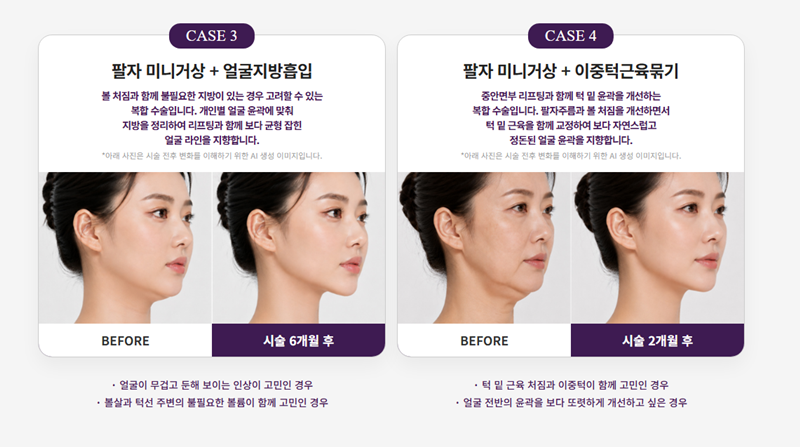
Just because your nasolabial folds have deepened does not necessarily mean you need a Midface Mini Facelift.
However, if your nasolabial folds, which you didn't worry about before, are getting deeper, and at the same time your cheeks are sagging or your mid-face feels heavy,
In addition to simply filling the sagging area of the nasolabial area, you can also consider lifting the sagging tissue itself.
The Midface Mini Facelift lifts subcutaneous tissue such as sagging cheeks and SMAS layer through small incisions.
You can take an approach to improve nasolabial folds and mid-face sagging by organizing the necessary skin.
In the end, the most important question is Not “How do I get rid of nasolabial folds?” “Why did my nasolabial folds get deeper?”It is.
The appropriate method may vary depending on whether the cause of nasolabial folds is simple sagging, sagging cheeks, decreased skin elasticity, or a combination of factors.
Therefore, if you are considering a Midface Mini Facelift, rather than just looking at the nasolabial folds, consider the position and volume of the cheeks, skin elasticity, sagging of the middle and lower face,
It is important to check the balance of the entire face before deciding whether to undergo surgery.
 다음글
다음글 게시물이 없습니다.

 힙업리프팅으로 애플힙 뒤태 만들수있나요? 힙업성형 Q&A
 어깨필러 상담부터 시술과정까지, 직각어깨 REAL 현장
 쌍수하고 술 언제부터 마셔도 되나요?


 이전글
이전글