
HERSHE News
If You Use Your Forehead to Open Your Eyes, Do You Need Upper Blepharoplasty?
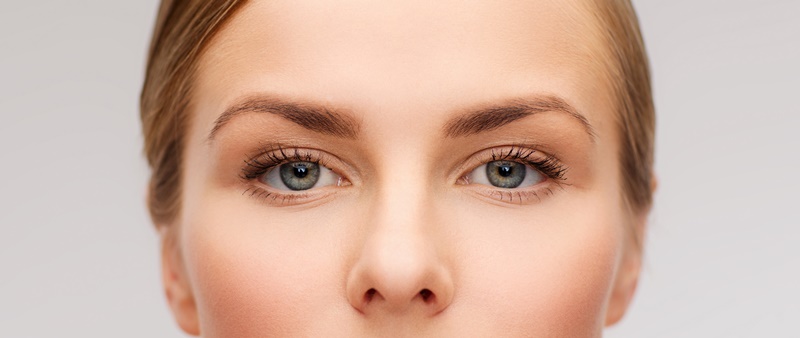
Do you tend to raise your eyebrows or tense your forehead when opening your eyes?
Some people do not notice it in the mirror, but in photos their forehead lines appear more prominent,
their eyelids feel heavy, or their double-eyelid crease seems more covered than before.
These changes may simply be habitual, but they can also occur when the upper-eyelid skin droops or the function used to open the eyes changes.
One procedure that may be considered in this situation is upper blepharoplasty.
However, using the forehead to open the eyes does not mean that upper blepharoplasty is necessary in every case.
The appropriate approach may differ depending on whether the issue is sagging eyelid skin, the function of the muscles that lift the eyelids, or the position of the eyebrows.
Today, based on information about upper blepharoplasty,
we will look closely at why people use their forehead to open their eyes, when upper blepharoplasty may be considered, and what should be checked before surgery.

Why Do You Use Your Forehead When Opening Your Eyes?
Opening the eyes involves the muscles that lift the upper eyelids and the surrounding tissues. If the eyelid skin becomes lax or
the function used to open the eyes changes, a person may develop the habit of using the forehead muscles and eyebrows together to open the eyes more comfortably.
The main reasons the forehead may tense in this situation include the following.
1. Sagging upper-eyelid skin
: As skin elasticity decreases with age, the upper-eyelid skin may sag downward.
The sagging skin may cover the double-eyelid crease or fold over the upper eyelid, making the eyes feel heavy.
In this situation, a person may develop the habit of raising the eyebrows to secure a clearer field of vision when opening the eyes.
Repeated use of the forehead muscles may also make forehead lines appear more noticeable.
2. Reduced eyelid-lifting function
If the muscles that lift the eyelids become weaker, compensatory use of the forehead may occur when opening the eyes.
In this case, it is important to distinguish simple skin laxity from a problem with the eyelid-lifting function itself.
If sagging skin is the primary cause, upper blepharoplasty may be considered, but
if a problem with eyelid-lifting function is identified, another surgical approach, such as correction of drooping eyelids, may need to be considered.
3. Lowered eyebrow position
When the eyebrows descend, more skin may appear to cover the upper eyelids.
In particular, sagging skin near the outer corners can make the eyes appear heavy or create a constricted feeling.
In this situation, the position of the eyebrows and the effect of the surrounding tissues on the eye shape should be assessed rather than examining only the eyelid skin.
As such, using the forehead to open the eyes can result from several different causes.
Rather than deciding on a surgical method based on one symptom alone, the eyelid and eyebrow positions and the function used to open the eyes should be assessed together.
Should You Consider Upper Blepharoplasty If You Use Your Forehead to Open Your Eyes?
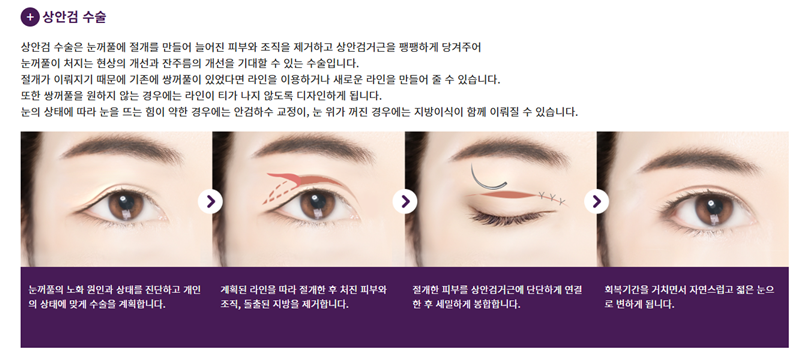
Upper blepharoplasty is surgery that assesses sagging upper-eyelid skin and surrounding tissues and adjusts them within the necessary range.
HERSHE Plastic Surgery's content on upper blepharoplasty also notes situations in which the eyelids sag and opening the eyes feels uncomfortable,
the double-eyelid crease is covered, or the forehead muscles are used extensively when opening the eyes as circumstances in which upper blepharoplasty may be considered.
If the following changes appear together, it may be helpful to have the current condition of the eyes assessed.
1. Raising the eyebrows whenever opening the eyes
If the eyebrows rise unconsciously or the forehead tenses when opening the eyes, both eyelid skin laxity and eye-opening function should be evaluated.
2. Heavy upper eyelids that feel as though they cover the eyes
Sagging skin may overlap the upper eyelids and make the eyes feel constricted.
If the skin near the outer corners covers the eyes considerably or forms folds, it is advisable to assess the extent of sagging.
3. The existing double-eyelid crease becomes covered
A previously visible double-eyelid crease may become obscured by skin, or the creases of the left and right eyes may look different.
In this situation, the degree of skin sagging and the existing double-eyelid structure should be assessed together.
4. The eyelids make the field of vision feel restricted
Severe upper-eyelid sagging may cause discomfort as though the upper field of vision is obstructed.
If vision is actually affected, functional evaluation is important in addition to aesthetic considerations.
However, having the symptoms above does not necessarily mean that upper blepharoplasty is required.
Skin sagging should be distinguished from problems with eyelid function, and the method appropriate for the individual's condition should be determined.

Can Upper Blepharoplasty Also Improve Forehead Lines?
Frequent use of the forehead muscles when opening the eyes can make forehead lines appear more prominent.
For this reason, some people wonder whether upper blepharoplasty can also improve forehead lines.
When sagging upper-eyelid skin makes it difficult to open the eyes,
adjusting the lax skin through upper blepharoplasty may be considered as a way to reduce the burden involved in opening the eyes.
However, forehead lines are associated with various factors besides eyelid sagging, including skin elasticity, facial-expression habits, and eyebrow position.
Therefore, it is difficult to conclude that upper blepharoplasty alone will eliminate all forehead lines.
In addition, if the eyelid-lifting function itself is weak, adjusting the skin alone may not be sufficient.
What matters is assessing both the reason the forehead is being used and the condition of the eyelids, rather than deciding on surgery based only on forehead lines.
What Is the Difference Between Upper Blepharoplasty and Ptosis Correction?
If you use your forehead when opening your eyes, you may also have heard of ptosis correction in addition to upper blepharoplasty.
The two surgeries may be considered together for related concerns, but they differ in the area addressed and their purpose.
1. Upper blepharoplasty
Upper blepharoplasty primarily removes or adjusts lax upper-eyelid skin while considering the condition of the surrounding tissues to improve upper-eyelid sagging.
It may be considered when sagging skin covers the double-eyelid crease or the eyelids feel heavy.
Depending on the individual's eye condition, the fat and muscles and the existing double-eyelid crease may also be assessed.
2. Surgery that considers eyelid function, including ptosis correction
If weak eye-opening strength or insufficient eyelid elevation is identified, the eyelid-lifting function can be evaluated before considering the necessary correction.
These functional issues should be distinguished from skin sagging. Using the forehead to open the eyes alone is not enough to conclude that ptosis correction is needed.
3. Criteria for distinguishing the two surgeries
The choice between upper blepharoplasty and ptosis correction is made by comprehensively considering factors such as the following.
The degree of upper-eyelid skin laxity, eye-opening strength and eyelid movement, the existing double-eyelid crease and eye shape
eyebrow position and the habit of using the forehead muscles, eye-closing function and the amount of skin that can be removed
During consultation, it is therefore helpful to describe not only forehead tension but also discomfort when opening and closing the eyes and changes in the existing eye shape.
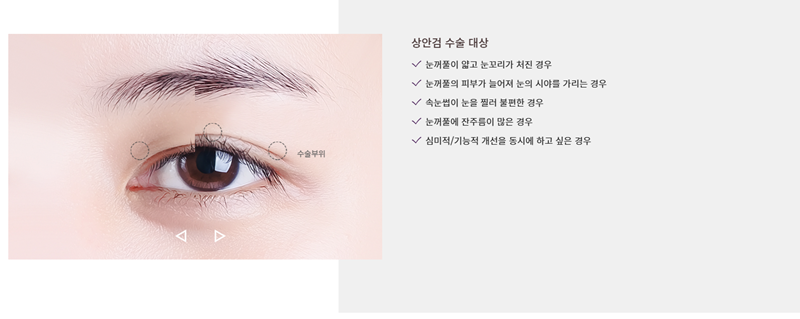
How Do Upper Blepharoplasty and Sub-Brow Lift Differ?
When researching ways to improve sagging eyelids, you may also encounter a procedure called a sub-brow lift.
Both may be considered for similar concerns involving sagging eyelid skin, but the surgical access area and the conditions that must be considered differ.
Upper blepharoplasty generally approaches through the area near the upper-eyelid crease to adjust lax skin and surrounding tissues.
It can also take into account refinement of the existing double-eyelid crease or changes to the eye shape.
A sub-brow lift approaches through the lower border of the eyebrow to adjust sagging upper-eyelid skin and tissues.
It may be considered when a person wishes to preserve the existing double-eyelid crease as much as possible.
However, a sub-brow lift cannot preserve the double-eyelid crease in every case, and upper blepharoplasty is not always the more suitable option.
The surgical method should be selected after comprehensively assessing where the sagging is concentrated,
the distance between the eyebrows and eyes, the amount of excess skin, and the existing eye shape.
Recovery and Precautions After Upper Blepharoplasty
If you are planning upper blepharoplasty, it is advisable to review the recovery process and precautions in advance as well as the surgical method.
Swelling, bruising, and a pulling sensation may occur after surgery, and recovery speed varies depending on the individual's condition and the extent of surgery.
During recovery, care for the wound according to the medical staff's instructions and avoid rubbing or pressing firmly around the eyes.
The timing for resuming exercise and daily activities should also be determined according to the state of recovery.
After surgery, various adverse effects may occur, including bleeding, infection, scarring, left-right asymmetry, and changes in the ability to open or close the eyes.
If unusual symptoms such as severe pain, changes in vision, or rapidly worsening swelling occur, seek prompt medical attention.
Before surgery, it is important to receive a full explanation of not only the expected changes but also the recovery process and possible adverse effects before making a decision.
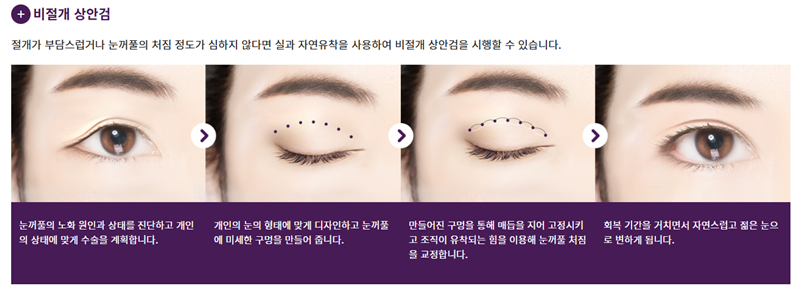
What to Check Before Upper Blepharoplasty
If you habitually use your forehead when opening your eyes, it is especially important to review the following points.
1. Degree of skin sagging
: Assess how much the upper-eyelid skin has sagged and how much it covers the double-eyelid crease or eye shape.
2. Eye-opening function
: Assess both the strength used to lift the eyelids and the ability to close the eyes. Skin sagging and impaired eyelid-lifting function should be distinguished.
3. Eyebrow position
: Assess whether lowered eyebrows are covering the eyelids and whether there is a habit of raising the eyebrows when opening the eyes.
4. Existing double-eyelid crease and eye shape
: Consider the individual's expectations and eyelid structure, including whether the existing crease should be preserved or a covered crease should be refined.
5. Condition of surrounding tissues, including skin and fat
: Comprehensively assess eyelid thickness, fat distribution, and left-right differences to determine the necessary surgical scope.
Through these evaluations, it is important to identify the cause of the current symptoms and determine whether upper blepharoplasty is appropriate or another method should be considered.

Using the forehead to open the eyes may be related to several factors, including sagging upper-eyelid skin,
changes in eyelid-lifting function, and eyebrow position.
Upper blepharoplasty may be considered when sagging upper eyelids are a concern, but the same surgery is not required in every case.
It is important to identify whether skin sagging is the main cause,
whether eye-opening function is impaired, and whether eyebrow position has an effect before selecting a method suited to the individual.
If you often tense your forehead when opening your eyes, your double-eyelid crease has become covered,
or your eyelids feel heavy, consider having the current condition of your eyes assessed first.
A thorough consultation and diagnosis can help determine a suitable direction for improvement.
 다음글
다음글 게시물이 없습니다.

 힙업리프팅으로 애플힙 뒤태 만들수있나요? 힙업성형 Q&A
 어깨필러 상담부터 시술과정까지, 직각어깨 REAL 현장
 쌍수하고 술 언제부터 마셔도 되나요?


PREFER TO CONTACT US DIRECTLY?
Choose one of the channels below to begin a direct conversation with our English consultation team.


 이전글
이전글