
HERSHE News
Double Chin Muscle Tightening: Can It Be Considered Even Without Much Fat Beneath the Chin?

Some people are not overweight and maintain a regular diet, yet remain concerned because the area beneath the chin looks particularly full.
It may not be very noticeable from the front, but in profile photos the boundary between the jaw and neck can appear indistinct,
or the tissue beneath the chin may fold when the head is tilted slightly downward.
When a double chin is a concern, it is natural to think first of fat beneath the chin.
However, a double chin is not caused solely by excess fat.
This is because several factors may act together, including the amount of submental fat,
the condition of the muscles beneath the chin, the distribution of deep-layer fat, skin elasticity, and facial bone structure.
Can Double Chin Muscle Tightening therefore be considered even when there is not much fat beneath the chin?
Today, we will take a closer look at HERSHE Plastic Surgery’s Double Chin Muscle Tightening, including the various causes of a double chin,
the surgical principle, how it differs from liposuction, and what should be checked before surgery.
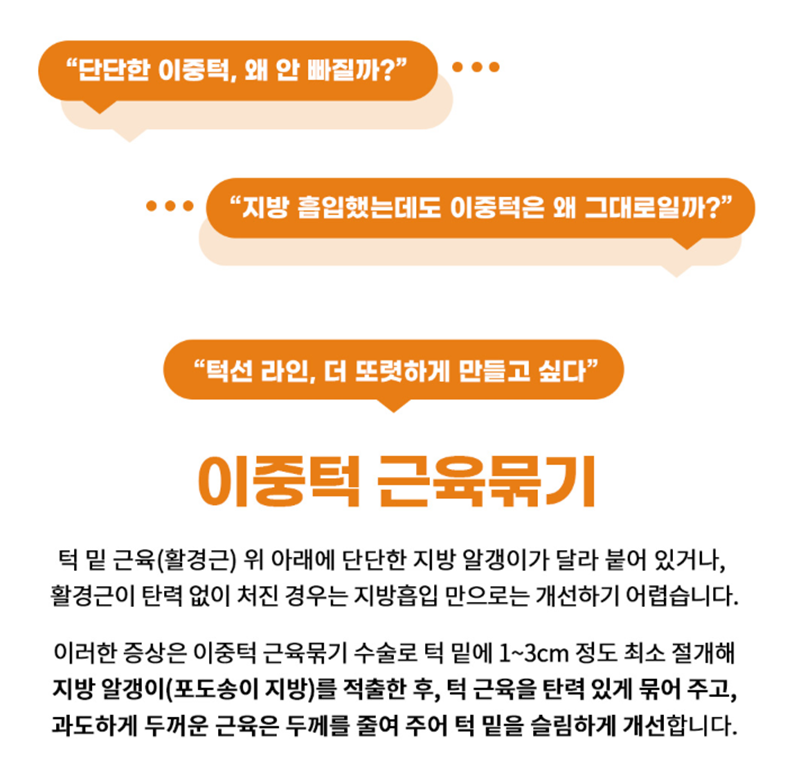
Why Can a Double Chin Develop Even Without Much Fat Beneath the Chin?
A double chin is generally thought to develop when fat accumulates beneath the chin.
Submental fat is, of course, one of the common causes of a double chin.
In practice, however, the area beneath the chin may look full or the jawline may appear less defined even when there is not much fat.
The following are some of the common causes to consider.
1. Laxity of the Platysma Beneath the Chin
The platysma is a thin muscle that extends broadly from the front of the neck to beneath the chin.
It is one of the structures that affects the contour beneath the chin and around the neck.
Over time, if the platysma becomes lax or the left and right sides separate, the supporting structure beneath the chin may change and the area may appear to sag.
In such cases, removing fat alone may not create the desired submental contour, so it is important to assess the position and condition of the muscle as well.
2. Deep-Layer Fat Around the Muscle
Fat beneath the chin does not exist in only one layer.
In addition to subcutaneous fat directly beneath the skin, fatty tissue may be distributed around the platysma or in deeper layers.
In particular, firm fatty tissue around the platysma can sometimes be difficult to address with conventional liposuction alone.
Rather than determining the cause of a double chin only by the amount of fat visible from the outside, it is therefore necessary to examine the layer in which the fat is located.
3. Reduced Skin Elasticity and Sagging
When skin elasticity decreases, the skin beneath the chin may loosen, making the boundary between the jawline and neck appear less distinct.
Even without much fat, downward sagging of the skin may then create a contour that resembles a double chin.
Because the appropriate surgical approach may vary according to skin thickness, elasticity, and the extent of sagging, the condition of the skin should also be assessed.
4. Facial Bone and Chin Structure
Facial skeletal factors—including the length and shape of the chin, the position of the chin tip,
and the angle formed by the lower jaw and neck—can also affect the submental contour.
For example, when the chin tip is positioned relatively far back or the angle between the jaw
and neck is shallow, a double chin may look prominent even when there is little submental fat.
Because several anatomical factors may contribute to a double chin, identifying the underlying cause is important.

What Is Double Chin Muscle Tightening, and Why Is the Muscle Assessed as Well as the Fat?
Double Chin Muscle Tightening is a surgery that corrects the structures beneath the chin by considering not only fat but also a lax or separated platysma.
Unlike an approach that simply removes submental fat, it also assesses the position and degree of muscle laxity and the distribution of deep-layer fat.
Because the platysma extends from beneath the chin into the neck, laxity or separation of this muscle can contribute to a less distinct boundary between the chin and neck.
In such cases, it is important to assess the muscle and plan the surgery accordingly rather than relying on fat removal alone.
Key Factors Assessed for Double Chin Muscle Tightening
1. Amount and distribution of subcutaneous fat beneath the chin
2. Degree of platysma laxity and separation
3. Deep-layer fat around the platysma
4. Thickness and elasticity of the skin beneath the chin
5. Skeletal structure of the chin tip and lower jaw
In other words, Double Chin Muscle Tightening does not focus solely on reducing fat beneath the chin.
Its aim is to refine the boundary between the jawline and neck by considering the muscular and fatty structures beneath the chin together.
However, muscle correction is not necessary for every double chin, and whether surgery is appropriate and how extensive it should be must be determined through an individual assessment.
How Does Double Chin Muscle Tightening Differ from Liposuction?
Liposuction is one of the procedures most commonly compared when considering improvement of a double chin.
Both approaches may be used when addressing the submental contour, but they differ in the main tissues assessed and in the surgical approach.
1. Double Chin Liposuction
This approach focuses on removing subcutaneous fat accumulated beneath the chin.
It may be considered when subcutaneous fat is the primary cause and skin elasticity and muscle condition are relatively good.
2. Double Chin Muscle Tightening
This surgery evaluates multiple contributing factors together, including subcutaneous fat, laxity or separation of the platysma, and deep-layer fat.
When muscle condition and deep-layer fat affect the submental contour, fat removal and muscle correction may be considered together.

Can Double Chin Muscle Tightening Be Considered Even Without Much Fat Beneath the Chin?
In conclusion, a consultation for Double Chin Muscle Tightening may be considered even when there is not much fat beneath the chin.
This is because the causes of a double chin are not limited to fat alone.
If you have any of the following concerns, the muscles beneath the chin, deep-layer fat, and skin condition may be assessed together.
1. A double chin that does not change significantly despite dieting
If the submental contour changes little even after weight loss, it is necessary to check whether structural factors other than fat are involved.
2. A jawline that looks less defined in profile than from the front
If the boundary between the jaw and neck is unclear in profile, the shape of the chin tip, the submental muscles, and fat distribution may be assessed together.
3. Sagging beneath the chin despite a small amount of submental fat
Reduced skin elasticity or laxity of the platysma may be contributing factors.
4. The area beneath the chin folds easily when the head is lowered
It is advisable to assess the movement of the skin and muscles when the head is lowered, together with the distribution of submental fat.
5. Fullness beneath the chin with an indistinct transition into the neck
The assessment may determine whether deep-layer fat and the condition of the platysma, as well as subcutaneous fat, are contributing.
However, having these characteristics does not mean that Double Chin Muscle Tightening is suitable for everyone.
The decision to proceed with surgery should be made after comprehensively assessing skin elasticity, muscle condition, the location of fat, and facial bone structure.
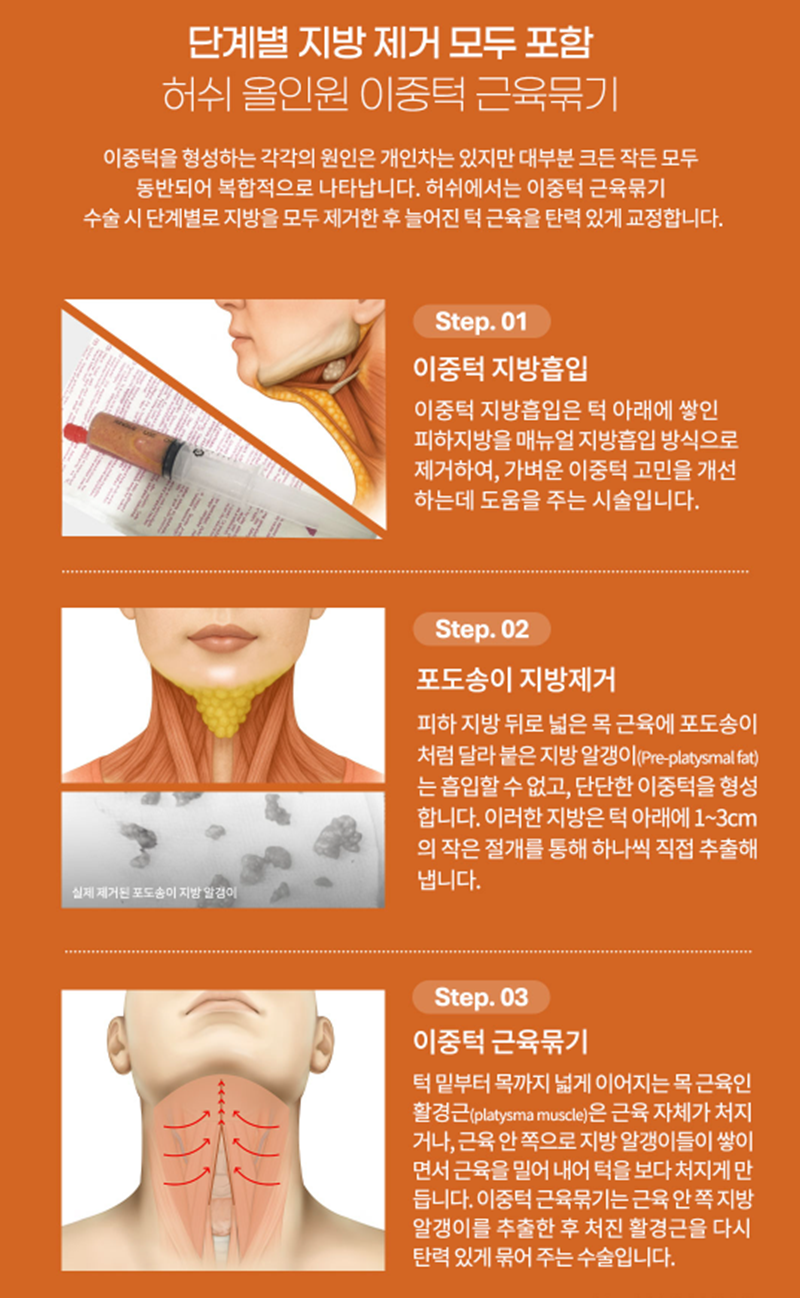
What Should Be Checked Before Double Chin Muscle Tightening?
Because Double Chin Muscle Tightening considers both fat and muscle beneath the chin, a thorough diagnosis and consultation before surgery are important.
It is advisable to check the following points in advance.
1. The Cause of the Double Chin Should Be Identified
It is necessary to determine whether fullness beneath the chin is caused by subcutaneous fat, deep-layer fat, or platysma laxity.
This is because the surgical method and extent may vary depending on the cause.
2. Skin Elasticity and the Degree of Sagging Should Be Assessed
Even after fat is removed, sagging skin may remain if skin elasticity is insufficient.
Therefore, skin thickness, elasticity, and the extent of laxity should be assessed together with the amount of fat.
3. The Chin Tip and Facial Bone Structure Should Be Considered Together
The angle between the chin and neck and the overall facial contour may appear different depending on the position of the chin tip and the shape of the lower jaw.
It is important to establish a surgical plan that also takes these structural factors into account.
4. The Postoperative Recovery Process and Precautions Should Be Reviewed
After surgery, swelling, bruising, tightness, soreness, and temporary changes in sensation may occur, and the recovery process differs from person to person.
It is advisable to follow the medical team’s guidance regarding postoperative care, follow-up visits, and the timing of return to daily activities.
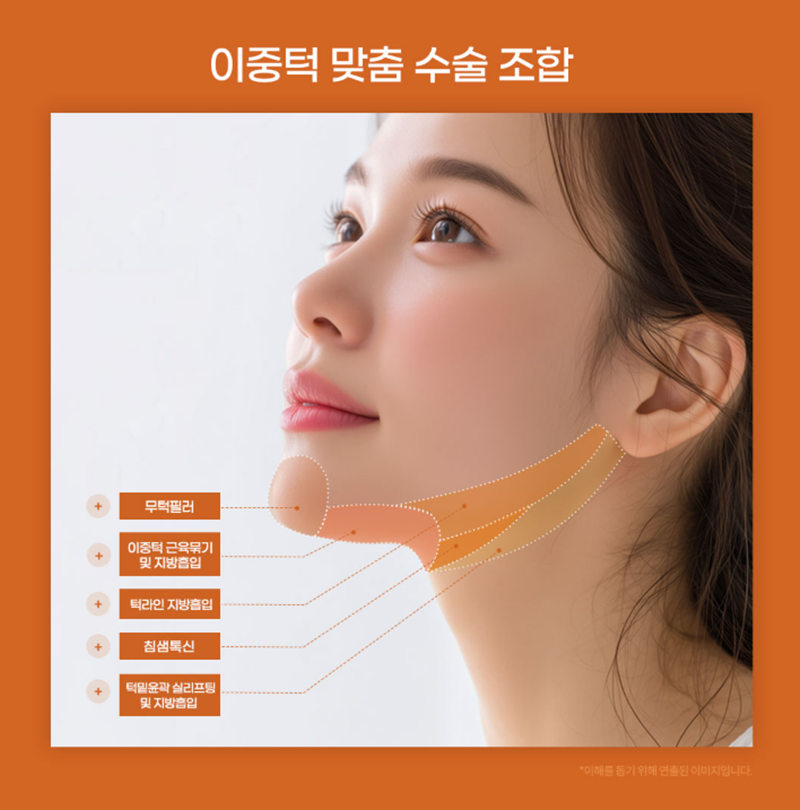
What Is the Recovery Process After Double Chin Muscle Tightening?
One of the main questions for people considering surgery concerns the recovery period.
The HERSHE Plastic Surgery website states that Double Chin Muscle Tightening takes approximately 1 hour and 30 minutes.
Sutures are removed on the seventh day after surgery, and the stated recovery period before returning to daily activities is approximately 1–2 weeks.
These are general guidelines provided on the website; actual recovery speed and the timing of return to daily activities may vary depending on the individual’s condition and the extent of surgery.
The following symptoms may occur after surgery.
1. Swelling beneath the chin and in the surrounding area
2. Bruising at the surgical site
3. A feeling of tightness or soreness beneath the chin
4. Temporary changes in sensation
5. Discomfort during healing of the incision
During the early stage of recovery, swelling and tissue tightness may make the submental contour feel somewhat unfamiliar.
Rather than judging the final result solely by the appearance immediately after surgery,
it is important to monitor the recovery process according to the medical team’s guidance.
If you have an important event or photo shoot scheduled, it is advisable to plan the surgery with sufficient recovery time in mind.

A double chin is not simply a problem caused by excess fat beneath the chin.
Multiple factors may contribute, including the amount and location of subcutaneous fat,
laxity or separation of the platysma, deep-layer fat, skin elasticity, and the structure of the chin tip and facial skeleton.
Therefore, having little submental fat does not necessarily mean that muscle correction is unnecessary; conversely,
the presence of a double chin does not mean that muscle tightening is always required.
Taking these differences into account, HERSHE Plastic Surgery assesses facial structure, skin condition,
and fat distribution and provides guidance on Double Chin Muscle Tightening based on an individualized surgical plan.
A key feature is the combined assessment of each factor, from subcutaneous fat and deep-layer fat to correction of the platysma beneath the chin.
Most importantly, the current cause of your double chin should be accurately identified.
If the area beneath your chin continues to look full despite dieting, or if your jawline appears indistinct in profile even though there is not much fat, consider having the condition of the muscles and skin assessed together with the fat.
 다음글
 게시물이 없습니다.


 힙업리프팅으로 애플힙 뒤태 만들수있나요? 힙업성형 Q&A
 어깨필러 상담부터 시술과정까지, 직각어깨 REAL 현장
 쌍수하고 술 언제부터 마셔도 되나요?


PREFER TO CONTACT US DIRECTLY?
Choose one of the channels below to begin a direct conversation with our English consultation team.


 이전글
